
From consensus to action: How open science serves as the "glue" for global collaboration
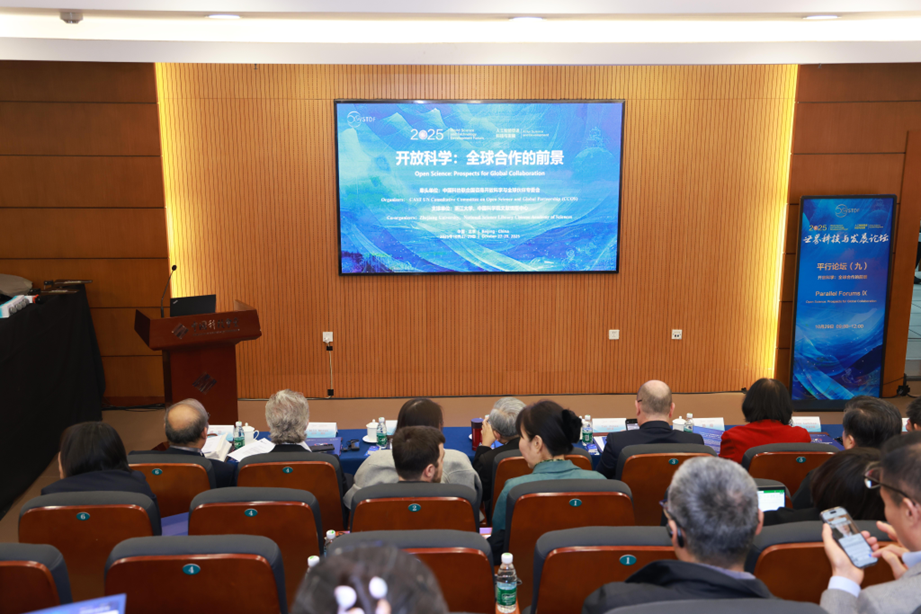
Knowledge knows no borders, and innovation requires collaboration. On October 29, 2025, as a key component of the China Association for Science and Technology's International Month 2025 focusing on "Global Scientific and Technological Collaboration," the parallel forum "Open Science: Prospects for Global Collaboration" of the 2025 World Science and Technology Development Forum was held in Beijing. Participants from governments of various countries, international organizations, publishing institutions, universities, and research institutions gathered to engage in in-depth dialogue on the equity, practical pathways, and future challenges of open science.
Equity as the Foundation: Bridging Global Development Gaps for Barrier-Free Knowledge Sharing
Data shows that researchers in the Global South face issues such as a lack of infrastructure, including databases and computing facilities. Among 77 member countries of the Global South, about one-third of them lack a national research and education network. Language barriers make it difficult for non-native English speakers to integrate into the global scientific discourse. Traditional evaluation systems, which emphasize high-impact journals, make it hard for their local contributions to gain recognition.
In her address, Zhong Wenyan, a senior official from the Department of International Cooperation at the Ministry of Science and Technology of China, stated that the value of open science lies not only in accelerating the flow of knowledge but also in enabling people from different regions and backgrounds, especially those in the Global South, to benefit more conveniently and equitably. Marcelo Knobel, Executive Director of the UNESCO-TWAS (The World Academy of Sciences), pointed out that developing countries are often marginalized, and fundamental structural inequalities need to be addressed.
Bill Moran, Publisher of the Science Family of Journals at the American Association for the Advancement of Science (AAAS), highlighted the challenge of costs, noting that high Article Processing Charges (APCs) can create inequality. This publishing model, centered around financial incentives, places researchers from the Global South in the dilemma of "wanting to publish open access but being unable to afford it."
Practice as the Key: Multi-stakeholder Collaboration to Implement Open Concepts
Open science is not an abstract concept; it needs to be translated into practical effectiveness through concrete actions. At the forum, innovative pathways shared by diverse stakeholders, including publishers, research institutions, and universities, showcased a vivid picture of open science moving from "consensus" to "action."
Tan Xueling, Director of Publishing Development Asia at PLOS, introduced that PLOS was among the first publishers with an open data sharing policy and has been evolved in this area since 2014. PLOS not only encourages the sharing of data, code, designs, and peer reviews but also explores new publishing models. Its "Open Science Indicators (OSI)" now cover 166,000 articles, and its preprint platform allows researchers to publish their findings immediately, accelerating knowledge dissemination.
Research institutions are tackling practical problems using "bottom-up" models. The GIES (Geographical Indications, Environment, and Sustainability) initiative led by Liu Chuang, a research fellow at the Institute of Geographic Sciences and Natural Resources Research, Chinese Academy of Sciences (CAS), is a typical representative. To date, GIES includes 27 cases from 13 provinces in China. This initiative integrates geographical indication data and brings together government, businesses, and consumers to achieve a triple win: "a better environment, quality products for consumers, and income for farmers," providing a model for how open science can serve public welfare.
Universities are integrating open science into their educational systems. Professor Li Min from the International Campus at Zhejiang University shared the "AI+X Micro-Certificate Program," where students from different majors across five universities take classes together, collaborate on assignments and papers, thereby enhancing teamwork. Furthermore, the Centrifugal Hypergravity and Interdisciplinary Experiment Facility (CHIEF) under construction at Zhejiang University was designed for open data sharing, allowing global researchers to access cutting-edge resources.
A Promising Future: Building Cooperation Platforms to Tackle Development Challenges with Innovation
Although open science has shown initial results, challenges such as lack of infrastructure, technical security, and insufficient international coordination remain to be overcome. The forum launched the "Open for Science"China Knowledge and Data Sharing Platform, offering a practical solution to these challenges.
Liu Xiwen, Director of the National Science Library, Chinese Academy of Sciences (CAS), explained that this platform integrates open knowledge and data to build an international cooperation network, providing researchers with better knowledge and data services. It will also offer open-source software toolkits to help developing countries build their own open science platforms, directly addressing the failing of one-third of member states lacking such infrastructure.
Regarding technical security and data transmission challenges, Zhu Ming, a research fellow from the National Astronomical Observatories of CAS, used FAST (the Five-hundred-meter Aperture Spherical radio Telescope) as an example. Due to the massive volume of data, transmitting it to international users is expensive and slow. In this context, AI technology becomes a crucial solution. Ewe Hong Tat, President of Tunku Abdul Rahman University of Management and Technology (Malaysia), believes that in the AI era, open science can follow a holistic education path to benefit the whole world. AI can both break down language barriers and efficiently manage massive data.
From co-building platforms to empowering through technology, from aligning concepts to implementing actions, the forum sent a clear message: open science is the "glue" for global scientific and technological cooperation. Only by basing efforts on equity, focusing on practice, and pooling strengths through collaboration can knowledge truly become a global public good benefiting all humanity, injecting sustained momentum into addressing global challenges and promoting sustainable human development.
Sources: gmw.cn, VOC