
Young scientists shaping the future: 2025 World Young Scientist Summit held in Wenzhou
The 2025 World Young Scientist Summit (WYSS) opened on Oct. 25 in Wenzhou, Zhejiang province, gathering nearly 800 scientists, entrepreneurs and innovators from 47 countries and regions under the theme "Embracing Change: Young Scientists Shaping the Future Together."
Co-hosted by the China Association for Science and Technology (CAST) and the People's Government of Zhejiang Province, the seventh edition of the summit highlighted how global collaboration and youth-driven innovation can power a sustainable and inclusive future.
Key speakers at the plenary session included Feng Shenhong, deputy secretary of CAST's Leading Party Members Group and vice president of CAST; Wang Cheng, deputy secretary of the CPC Zhejiang Provincial Committee; Donald Dingwell, president of the Academia Europaea and foreign member of the Chinese Academy of Sciences; and Zhang Zhenfeng, deputy governor of Zhejiang province and secretary of the CPC Wenzhou Municipal Committee.
Youth leading frontier innovation
Feng Shenhong called on young scientists to lead exploration in cutting-edge fields such as artificial intelligence, quantum information, nuclear fusion energy and biomanufacturing, urging them to "venture into the uncharted zones of science and innovation." He also emphasized that technological progress must remain aligned with ethics and human welfare.
"Science knows no borders, and innovation has no boundaries," Feng said. "In addressing global challenges such as climate change, energy security and public health, young scientists should stand together to inject youthful dynamism into the building of a community with a shared future for humanity."
Wang Cheng described Zhejiang province as a vibrant hub for innovation and entrepreneurship, home to emerging companies such as DeepSeek and Unitree Technology. He underscored Zhejiang's commitment to advancing AI, deepening integrated reform in education, science and talent, and strengthening global cooperation.
"We are more eager for talent than ever before," Wang said. "The WYSS provides a vital platform for young scientists to connect, collaborate and advance international cooperation."
Donald Dingwell, spoke gently yet firmly about the importance of supportive systems. He emphasized the need to build a culture that treats failure with kindness, noting that major cognitive breakthroughs often emerge from setbacks.
Honoring innovation for sustainability
One of the summit's highlights was the presentation of the 2025 Young Scientist Sustainable Development Goals Award, recognizing four outstanding researchers for their contributions to advancing the U.N. sustainable development goals (SDGs).
This year's laureates are: Liu Yingjun, co-founder and CTO of Porotech (U.K.), for breakthroughs in porous semiconductor materials and sustainable microLED technology; Mariangela Russo, professor at the University of Turin (Italy), for her discovery of stress-response mechanisms in colorectal cancer cells; Wolfgang Tress, professor at the Zurich University of Applied Sciences (Switzerland), for innovations in organic and perovskite photovoltaic materials; and Wang Hui, professor at the University of Science and Technology of China, for pioneering research in photonic quantum computing.
In their acceptance speeches, the winners highlighted the shared responsibility of science toward global sustainability. "We are advancing clean and sustainable futures," Tress said. Meanwhile, Liu pledged to "tell the story of innovation inspired by Chinese culture."
Supporting next generation of scientists
At the plenary session, the World Association of Young Scientists (WAYS) released several landmark studies, including the "Global Survey on Early-Career Young Scientists' Growth and Development" and the "Research Report on the Global Distribution and Mobility of Young Scientists in AI."
WAYS chairperson Lu Chaoyang noted that young researchers face significant pressures — from limited funding and administrative burdens to career instability. "They need stable financial support, independent research space and fair opportunities to grow," Lu said.
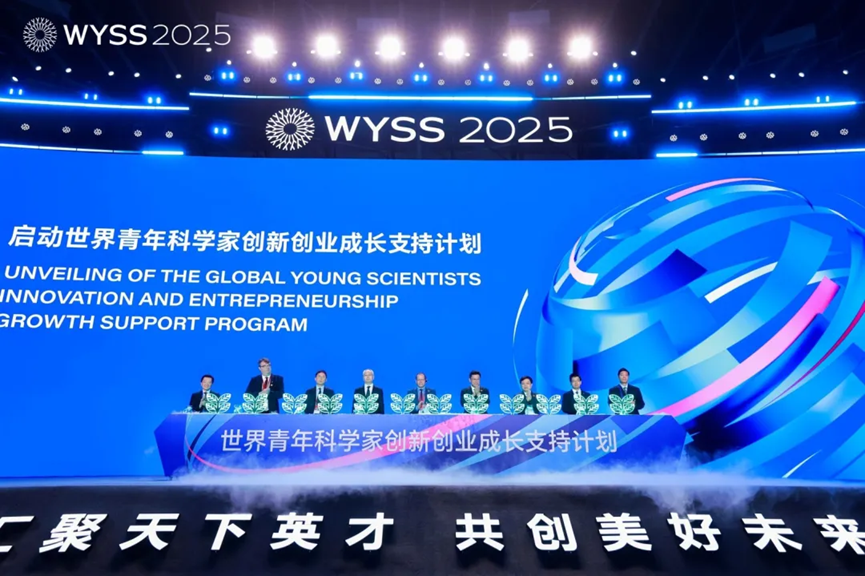
To address these challenges, the summit launched the Global Young Scientists Innovation and Entrepreneurship Growth Support Program, which includes: co-publishing an international journal with the Institute of Physics Publishing (U.K.), joint nuclear science training programs with the China National Nuclear Industry Joint Graduate School, a special enterprise support initiative with listed companies, and the formation of the WYSS Venture Fund Alliance.
WAYS also unveiled the Global Young Scientist Pioneers Under 35 (WAYS-2035) list to recognize emerging scientific leaders worldwide.
Spotlight on brain-machine intelligence
The China Brain-Machine Intelligence Rising Star Awards were also presented at the summit, recognizing six outstanding young researchers aged under 40 in brain-inspired intelligence and brain-computer interfaces.
The awardees included Wu Yujie (Hong Kong Polytechnic University), Ma De (Zhejiang University), Yu Zhaofei (Peking University), Liu Quanying (Southern University of Science and Technology), Yang Yuxiao (Zhejiang University) and Zheng Weilong (Shanghai Jiao Tong University).
Professor Pan Gang, director of the State Key Laboratory of Brain-Machine Intelligence at Zhejiang University, noted, "These honors encourage young scientists to explore frontier intersections of neuroscience and AI."
Innovation meets industry
Innovation and entrepreneurship were another core focus of this year's summit. During the Quickfire Talks session, four entrepreneurial teams presented pioneering work bridging science and industry.
Speakers included Zhang Rui, chairman of Beijing ARTrobot Technology Co. Ltd.; Andy Sode Anker, postdoctoral researcher at the Technical University of Denmark; Xu Jiajia, CEO of Lingyang Industrial Internet Co. Ltd.; and award winner professor Mariangela Russo.
They explored topics from bionic engineering and renewable energy to industrial AI transformation and biomedical innovation, demonstrating how scientific creativity translates into industrial impact.
Wenzhou, which established China's first municipal-level AI Bureau, is also becoming a national model for AI-powered urban development. "We aim to deepen collaboration in strategic key projects and promote intelligent applications," said Wang Jun, deputy secretary of the CPC Wenzhou Municipal Committee.
Science engaging society: "Universal Gravitation π"
The "Universal Gravitation π" Showcase — a 20,000-square-meter exhibition of frontier technologies — embodied the WYSS's vision of connecting science with society. Featuring more than 100 enterprises and 200 innovations, the event displayed such products as DEEP Robotics' X30 quadruped robot, ULS Robotics' exoskeleton, Lingban Technology's AR glasses, and green-energy vehicles such as BYD's U series range.
Wenzhou-based innovators also showcased biomedical and neuro-tech products, illustrating the city's transformation from "Made in Wenzhou" to "Smart Manufacturing in Wenzhou." The pavilion featured products demonstrating "Innovative China" in Wenzhou, organized by the Wenzhou Science and Technology Bureau, presenting data-driven insights into the region's innovation progress.
A parallel doctoral recruitment fair brought together over 100 employers and more than 300 positions across frontier fields including new energy, biomedicine and intelligent manufacturing — linking young scientists with real-world opportunities.
Platform connecting the world
After six years of continuous growth, the WYSS has evolved from a high-level dialogue into a global bridge connecting ideas, industries and generations. Through 11 parallel forums — from "Machine Learning for Science" and "Manufacturing Paradigm III" to "Quantum Photonics" and "Youth Entrepreneurship" — the summit fostered a complete ecosystem of innovation.
As Zhang Zhenfeng summarized: "When science meets industry, and youth meets opportunity, innovation naturally blooms."
The summit's solid outcomes reflect China's ongoing efforts to build a more open and dynamic innovation ecosystem—one where young scientists lead the way, collaboration among academia, industry and research drives progress, and public scientific literacy provides fertile ground for sustainable growth.
Source: VOC