
Brian Schmidt
Energy transition requires global cooperation. (By Brian Schmid)
On October 11, Professor Brian Schmidt, a Nobel laureate in physics, fellow of the Australian Academy of Science, and former Vice-Chancellor of the Australian National University, delivered a keynote speech titled “Climate Change: A Global Challenge for Science and Society” at the 17th U.S.-China Green Energy Forum. In his address, he outlined the global challenges that climate change poses to both science and society.
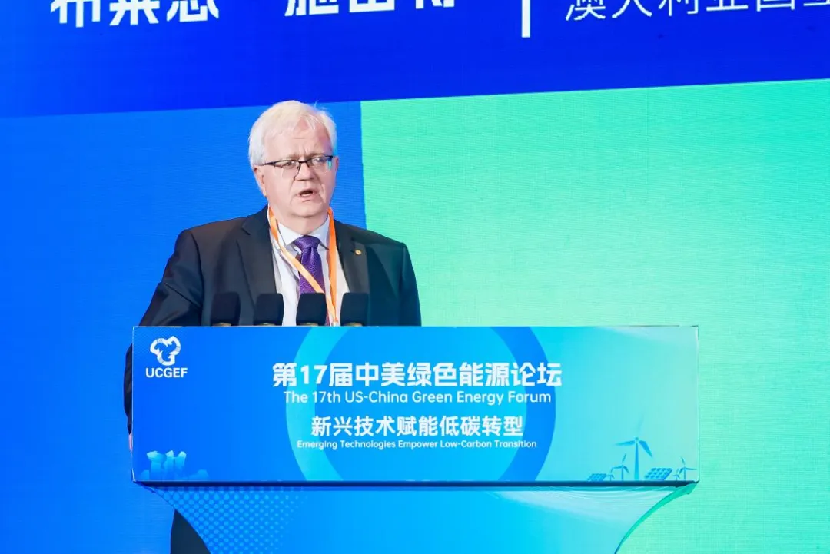
He proposed that to effectively accelerate the reduction of greenhouse gas emissions, it is essential to establish a globally unified carbon price, creating a market mechanism to drive the energy transition forward.
Schmidt noted that the premature phase-out of coal from the power market could threaten grid stability. Corresponding incentive policies are needed to promote the stable growth of new energy sources. He highlighted that China’s significant efforts in developing new energy provide a valuable reference model for the world. The pathways for energy transition vary by country, as most nations lack the geographical area and climatic conditions to achieve self-sufficient balance with new energy alone. Therefore, international cooperation is crucial to jointly advance the energy transition and achieve low-carbon, sustainable development.
The 17th U.S.-China Green Energy Forum, hosted by the Chinese Society for Electrical Engineering and the U.S.-China Green Energy Council, was held in Hengqin, Guangdong Province from October 11 to 12, 2025. The forum focused on the theme “Emerging Technologies Empowering Low-Carbon Transition.” The event is part of a series of activities organized for the CAST International Month 2025: Openness, Cooperation, Trust.
Sources: Chinese Society for Electrical Engineering, VOC