
-
A new method in industrial separation of C2H2 from C2H4: Single-molecule traps in COFs
2024-08-22
Removing trace amounts of acetylene (C2H2) from ethylene (C2H4)-rich gas mixtures is vital for the supply of high purity C2H4 to the chemical industry and plastics sector. However, selective removal of C2H2 is challenging due to the similar physical and chemical properties of C2H2 and C2H4. Cryogenic distillation (also known as low-temperature rectification) is a widely used commercial separation process involving liquefying gas mixtures at very low temperatures (183-258 K with 7-28 bar) and then selectively distilling a specific gas component at its boiling point, which is expensive and energy intensive.
Dr. Wang’s team from North China Electric Power University has developed a new method for dynamic removal of trace amounts of C2H2 from C2H4-rich gas mixtures. The “single-molecule traps” strategy that tunes the electrostatic interactions between the one-dimensional (1D) channel of a covalent organic framework (denoted as COF-1) and C2H2 molecules greatly improve the adsorption selectivity of C2H2 over C2H4. C2H2 molecules are preferentially located in single-molecule traps in COF-1 adsorbent, comprising an ideal microenvironment formed by the O atom of a C=O group, N atom of a C≡N group, and H atom of a phenyl ring in the 1D channels. COF-1 delivered a high affinity for C2H2 at ultralow pressures, which is relevant to the practical challenges of purifying C2H4 feedstocks in industry.
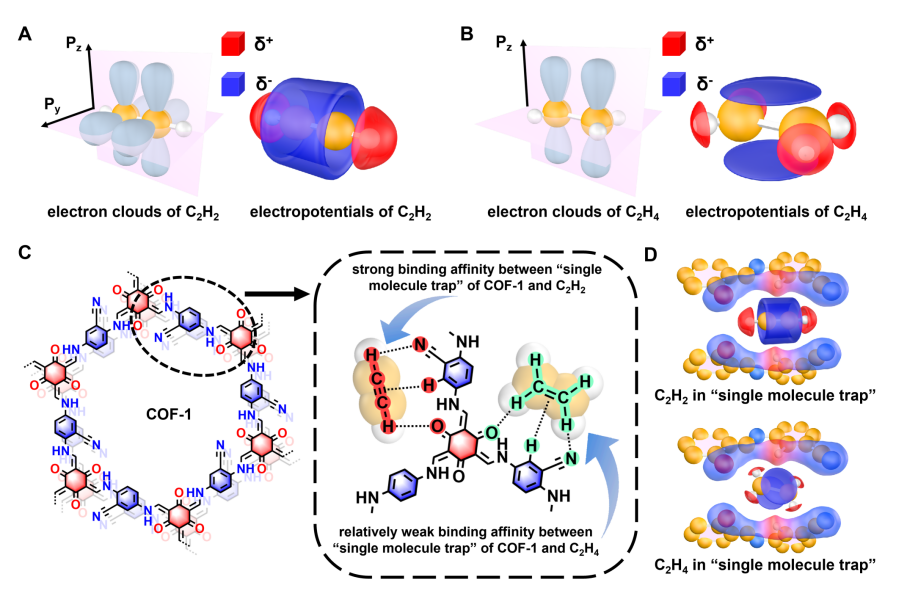
Image: The strategy of “single-molecule traps” in molecular level explanation.
By providing a clear illustration of the structure-separation performance relationship, which relies on the differing adsorption affinity of COF-1 for C2H2 and C2H4 at a molecular level, this study guides the rational development of COF-based adsorbents for removing trace C2H2 from industrial produced C2H4, thus delivering high-purity C2H4 gas.
Tag: Advanced Manufacturing
Sources: https://spj.science.org/doi/10.34133/research.0458