
-
De Novo Design of Artificial Cytochrome P450 Enzymes Based on Diffusion Model
2024-08-16
Cytochrome P450 enzymes are ubiquitous across almost all organisms and are renowned as “universal catalysts” due to their exceptional ability to selectively oxidize inert C-H bonds. Despite the Nobel Prize-winning work of Frances Arnold, who developed methods for obtaining new functional P450 enzymes through directed evolution, this approach is extremely time-consuming and labor-intensive. Efficiently designing P450 enzymes with new functions remains a significant challenge.
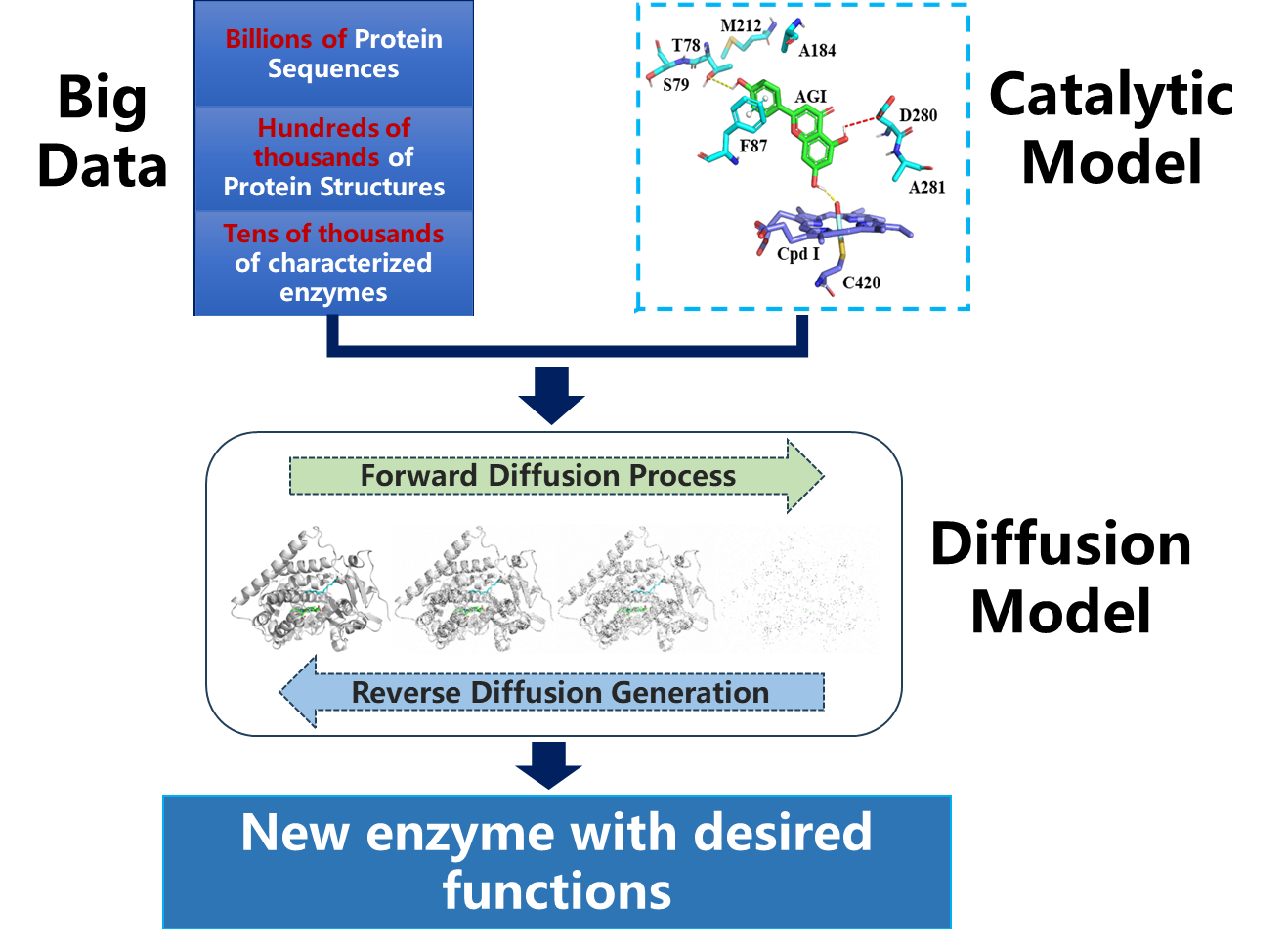
Researcher Jiang Huifeng and his team at the Tianjin Institute of Industrial Biotechnology, Chinese Academy of Sciences, have tackled this challenge by focusing on the key P450 enzyme (F6H) for synthesizing the cardiovascular drug breviscapine. Initially, they used evolutionary analysis to uncover the molecular mechanism behind the origin of the 6-hydroxylation function in flavonoids, which is caused by mutations in five ancestral residues in the F6H catalytic pocket. They then proposed the "three-point fixation principle" for the design of new P450 enzyme functions. Using this principle, the researchers combined it with a deep learning diffusion model to develop a new enzyme design method (P450Diffusion). P450Diffusion was pre-trained on over 200,000 P450 enzyme sequences and fine-tuned using enhanced sampling to generate novel P450 proteins. The team generated 60,000 non-natural P450 enzyme sequences using P450Diffusion and virtually screened 17 of these sequences for experimental evaluation. Results showed that six of the designed enzymes had catalytic capabilities superior to the natural F6H, with the highest activity increased by 3.5 times, demonstrating the model's significant potential in the de novo design of P450 enzymes.
This study provides new insights for designing novel functional P450 enzymes by integrating deep learning diffusion models, extensive P450 sequences, and the P450 enzyme pocket design principle. In the future, this method is expected to play an important role in bioengineering and industrial catalysis, driving the development and application of new enzymes.
Tag: Health Science
Sources: https://spj.science.org/doi/10.34133/research.0413