
Electroactive microbes “short-circuit” the passive film to corrode stainless steel
Key Takeaway
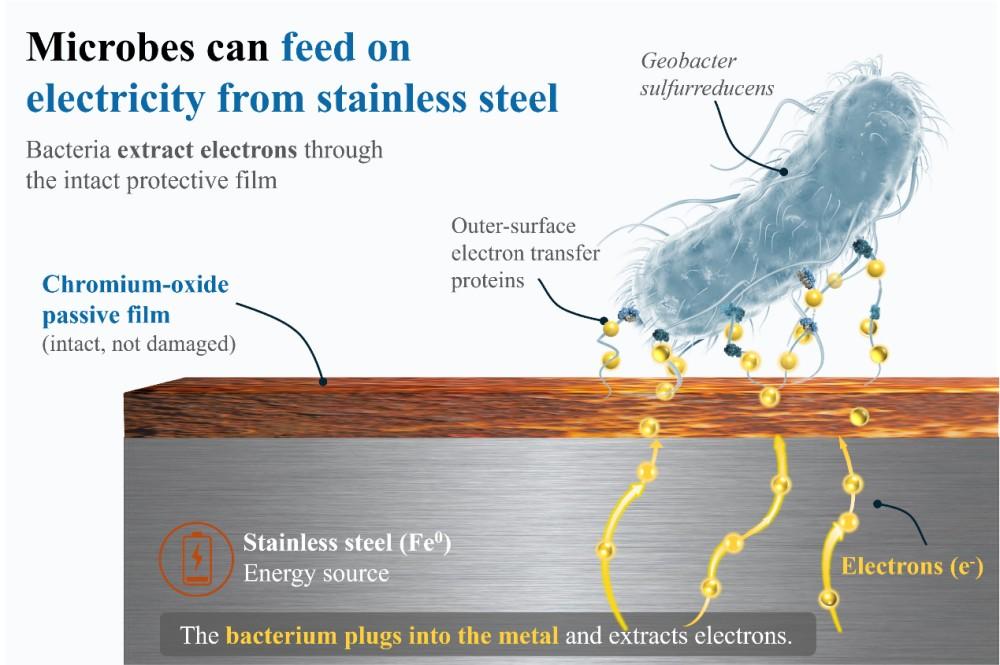
Scientists have discovered that the electroactive bacterium Geobacter sulfurreducens can extract electrons directly from stainless steel to power its metabolism. Surprisingly, this is accomplished without destroying the metal’s protective chromium-oxide passive film, revealing a new mechanism by which microbes can accelerate corrosion of materials widely used in infrastructure and industry.
Background
Microbial corrosion is one of the most economically damaging microbial processes, contributing to the deterioration of pipelines, industrial equipment, marine structures, and energy infrastructure worldwide. The global economic impact of corrosion is estimated to reach from hundreds of billions to potentially over a trillion dollars annually.
Stainless steel has been formulated to resist most forms of corrosion. It has a thin protective surface layer known as a passive film, which is composed primarily of chromium oxide. This film usually prevents corrosive chemicals and microbes from accessing the underlying iron metal and acts as an electronic barrier that inhibits electron transfer from the metal to external electron acceptors.
Recent studies have suggested that certain electroactive microorganisms may nevertheless accelerate corrosion of stainless steel. The prevailing hypothesis was that microbes degrade the passive film, eventually breaching it to directly contact the underlying metallic iron and extract electrons. However, the precise mechanism by which electroactive microbes interact with the stainless steel passive film had not been experimentally evaluated.
Research Progress
To investigate how electroactive microbes interact with stainless steel surfaces, a research team led by Prof. Dake Xu at Northeastern University (China) and Prof. Derek R. Lovley at Northeastern University and the University of Massachusetts Amherst conducted detailed studies with the electroactive bacterium Geobacter sulfurreducens.
Geobacter species are common microorganisms in soils and sediments that are known for their ability to exchange electrons with external materials such as minerals and other microbial species. These microbes possess specialized outer-surface proteins that enable extracellular electron transfer.
The research team examined corrosion of 316L stainless steel, one of the most corrosion-resistant stainless steel alloys, using high-resolution transmission electron microscopy, time-of-flight secondary ion mass spectrometry (ToF-SIMS), and electrochemical measurements. These methods enabled the researchers to evaluate structural, chemical, and electrical changes in the passive film during microbial corrosion.
The study revealed that the stainless steel passive film remained largely intact during microbial corrosion. High-resolution microscopy showed that while the outer iron oxide portion of the passive film could be partially altered, the underlying chromium-oxide layer, the key protective component of the passive film, remained continuous. Hydrogen gas, a common intermediate of iron corrosion, was not produced, demonstrating that the passive film continued to shield the underlying iron from chemical attack. Despite this intact barrier, Geobacter was able to extract electrons from the underlying iron to support its growth. Geobacter ‘plugged into’the stainless steel with its outer-surface electron transport proteins, lowering the activation energy required for electron transfer across the chromium oxide layer. Under these conditions the stainless steel functioned much like a battery, providing Geobacter with a steady flux of electrons as an energy source. These findings demonstrate that electroactive microbes can effectively “short-circuit” the protective passive film, drawing electrons from the metal without physically destroying the barrier.
Future Prospects
The discovery that microbes can extract electrons through intact passive films has important implications for corrosion science and materials engineering. Preventing microbial corrosion will require new strategies that provide better electrical insulation against the electron-withdrawing action of electroactive microbes like Geobacter.
More broadly, the results suggest that microbes may be able to exchange electrons with a wider range of materials than previously recognized, potentially influencing processes in natural environments as well as engineered bioelectronic systems.
Improved understanding of these processes is expected to aid in the development of more corrosion-resistant alloys, protective coatings, and technologies for managing microbial corrosion in industrial and environmental systems.
Journal
Research
DOI
https://doi.org/10.34133/research.1185
Method of Research
News article
Subject of Research
Electromicrobiology and microbiologically influenced corrosion
Article Title
Electroactive Microbes Short-Circuit the Passive Film to Corrode Stainless Steel
Article Publication Date
6-Mar-2026
Media Contact
Tian Tian
Research
tiantian@cast.org.cn
Expert Contacts
Dake Xu
School of Materials Science and Engineering
Northeastern University, Shenyang, China
xudake@mail.neu.edu.cn
Derek R. Lovley
School of Materials Science and Engineering
Northeastern University, Shenyang, China
Department of Microbiology
University of Massachusetts Amherst, USA
derek.lovley@gmail.com